Do Air Purifiers Help You Sleep Better?
Air purifiers with good particle filters can reduce airborne particles such as dust, pollen, pet dander and smoke in a room. That's not the same as proving they improve sleep, and the direct sleep evidence is limited and mixed. For most people, reducing sources and improving ventilation come first. Filtration may be worth trying if you have allergies or live with smoke or other particle pollution.
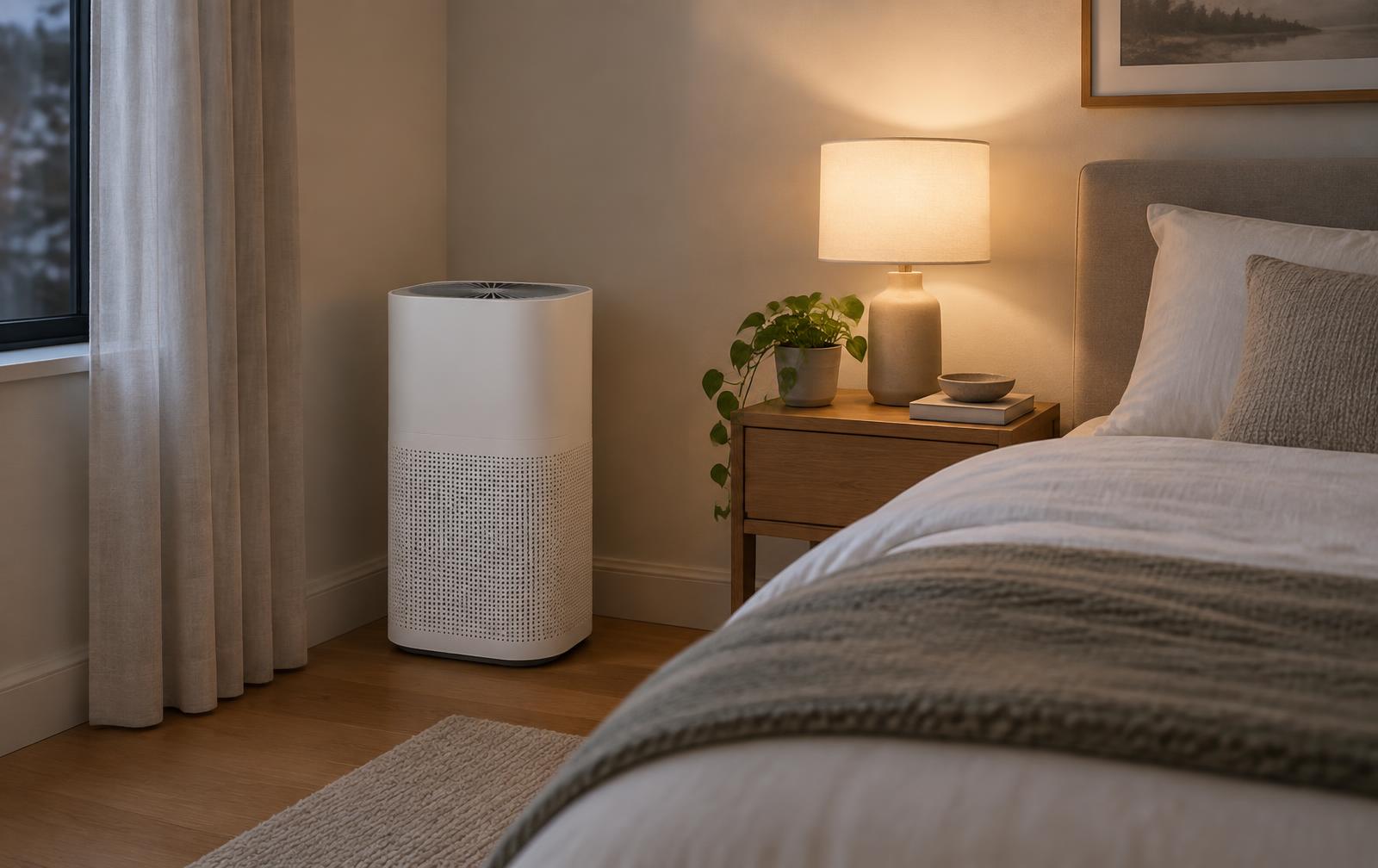
- Portable air cleaners with HEPA filters can reduce airborne particles, but they don't remove all pollutants, and the EPA recommends source control and ventilation first.[1][2]
- Evidence that air purifiers improve sleep is limited and mixed.[3][4]
- An air purifier may be worth trying if you have allergies, asthma, or smoke or particle pollution indoors—not as a general sleep aid for everyone.
- Size, placement, noise and filter replacement all affect whether a purifier helps in practice.
The short answer
An air purifier can clean particles out of the air in a room. Whether that translates into better sleep depends on whether airborne particles are actually affecting you. For many people they aren't, and a purifier won't change much. For people with allergies or poor indoor air, it may be a reasonable experiment.
What air purifiers can and cannot remove
Portable air cleaners with high-efficiency particulate air (HEPA) filters are designed to capture airborne particles such as dust, pollen, pet dander and smoke. They're less effective for gases unless they include materials designed for that purpose, and they can't remove allergens that have settled into bedding, carpets and furniture. The EPA recommends avoiding air cleaners that intentionally produce ozone.[1]
What the evidence says
Evidence that filtration reduces airborne particles is well established. Evidence that it improves sleep is much thinner, and it's important not to confuse the two.
In a randomized controlled trial of people with asthma, the use of air purifiers was compared with a placebo. The study reported effects on rhinitis quality of life and on how participants perceived their sleep. The trial was sponsored by an air purifier manufacturer and is published as a short research letter, so its findings should be interpreted cautiously.
A randomized, double-blind crossover trial in 80 college students in China compared real and sham filtration in dormitories. Real filtration improved morning cognitive test scores and nighttime blood-oxygen levels. The study focused on cognition rather than whether people slept better, and the results may not apply to homes with cleaner air.[2][3][4]
Who might reasonably consider trying filtration
People with allergies whose symptoms continue after bedding, cleaning and pet changes; people with asthma, following their clinician's advice; people living with indoor smoke, wildfire smoke or other particle pollution; and people who can't easily improve ventilation. If none of these situations apply, there may be less reason to make a purifier one of your first sleep-environment changes.
Why source control and ventilation come first
The EPA describes three basic strategies for improving indoor air—source control, ventilation and air cleaning—and notes that the most effective ways to improve indoor air are usually to reduce or remove sources of pollutants and to ventilate with clean outdoor air. Filtration is a useful supplement, not a replacement.[2]
What you can try
If you decide to try a purifier, these practical points make the experiment fairer.
- 01
Match it to the room
The EPA suggests choosing a portable air cleaner with a clean air delivery rate (CADR) large enough for the room it will be used in.
- 02
Place it well
Put it in the bedroom, where it has space around it and air can flow freely, with doors and windows closed while it runs.
- 03
Check the noise
Some units are loud on higher settings. A quieter setting you'll actually use overnight is better than a powerful setting you turn off.
- 04
Keep up with filters
Replace filters as the manufacturer recommends; a clogged filter works less well.
- 05
Judge after a few weeks
Notice whether congestion or sleep changes. If nothing changes, airborne particles may not be your main issue.
What this may mean for you
Your Sleep Plan doesn't recommend an air purifier by default. If your answers pointed to allergies or congestion, start with the free bedding, cleaning and ventilation steps. Filtration is an option to consider later if symptoms continue.
How this relates to the SleepWell360 Sleep Drivers
Airflow is one of the six SleepWell360 Sleep Drivers. It covers how fresh, clean and comfortable the air in your bedroom feels, including ventilation, humidity, allergens and congestion. It overlaps closely with Temperature (opening a window or running a fan changes both) and sometimes with Sound (a fan or purifier also adds background noise). Breathing problems during sleep, such as loud snoring with pauses or gasping, are handled separately as a safety signal rather than as an Airflow issue.
Continue Improving Your Sleep
Nighttime Allergies and Congestion: How to Improve Your Bedroom
Common bedroom allergens, why symptoms can feel worse at night, a practical order for testing bedroom changes, and when congestion needs a healthcare professional.
Read Guide
How Air Quality Affects Sleep
What SleepWell360 means by Airflow, what research shows about bedroom ventilation, humidity and allergens, and practical free or low-cost changes to try first.
Read Guide
How Noise Affects Sleep
How environmental noise can disrupt sleep, why sudden sounds matter more than steady ones, why sensitivity varies, and how to tell whether sound is one of your Sleep Drivers.
Read GuideSources & Research
SleepWell360 articles provide general sleep education and are not medical advice.
- 1.U.S. Environmental Protection Agency: Guide to Air Cleaners in the Home
- 2.U.S. Environmental Protection Agency: Improving Indoor Air Quality
- 3.Clinical & Experimental Allergy: Effects of air purifiers on rhinitis quality of life and perception of sleep quality in people with asthma: randomised controlled trial (Kadalayil et al., 2024). The study reported manufacturer funding; findings should be interpreted in that context.
- 4.Environmental Science & Technology: Cognitive benefits of reducing indoor particulate matter exposure during sleep: a randomized, double-blind crossover trial (Yang et al., 2024)